

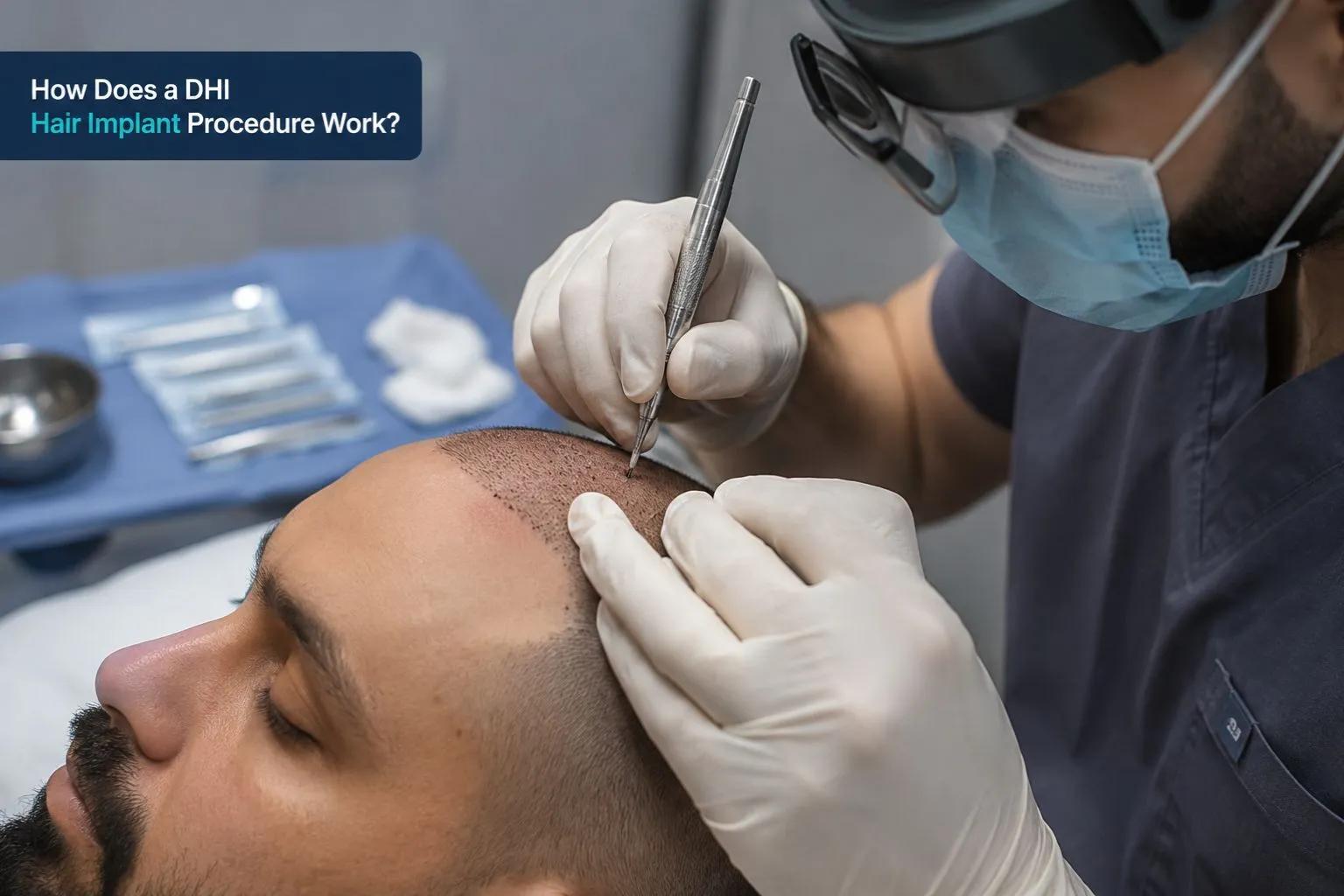
Losing hair is stressful enough without having to decode confusing medical jargon on top of it. If you've been researching hair restoration, you've probably come across the term DHI and wondered how it's actually different from a regular transplant, and whether it's worth the extra cost.
What Is a DHI Hair Implant?
A DHI Hair Implant is a modern form of hair transplant surgery where individual hair follicles are extracted from a donor area, typically the back of the scalp, and implanted directly into thinning or bald areas using a specialised pen-shaped tool. Unlike older techniques, there's no need to cut slits or channels into the scalp before placing the grafts. The tool does both jobs at once, which is why the technique is also called Direct Hair Implantation.
This one-step approach gives surgeons tighter control over the angle, depth, and direction of every single hair, which matters enormously when the goal is a hairline that looks like it was never touched.
DHI vs FUE vs FUT: What's the Real Difference?
All three techniques start the same way: follicles are harvested one by one from a healthy donor zone. Where they differ is in how those follicles get placed back in.
FUT (strip method): A strip of scalp is surgically removed, and follicles are separated from it under a microscope before implantation. It leaves a linear scar but can yield a large number of grafts in one sitting.
FUE (Follicular Unit Extraction): Follicles are extracted individually with a small punch tool. Recipient sites are then created with a blade or needle, and grafts are placed afterwards using forceps.
DHI (Direct Hair Implantation): A refinement of FUE that uses a Choi implanter pen to extract and implant in one continuous motion, skipping the separate channel-cutting stage entirely.
Because DHI grafts spend less time outside the body, survival rates tend to be higher, and the finer control over placement angle is why it's often recommended for hairline work and for patients who want a no-shave transplant.
How Does a DHI Hair Implant Procedure Work? Step by Step
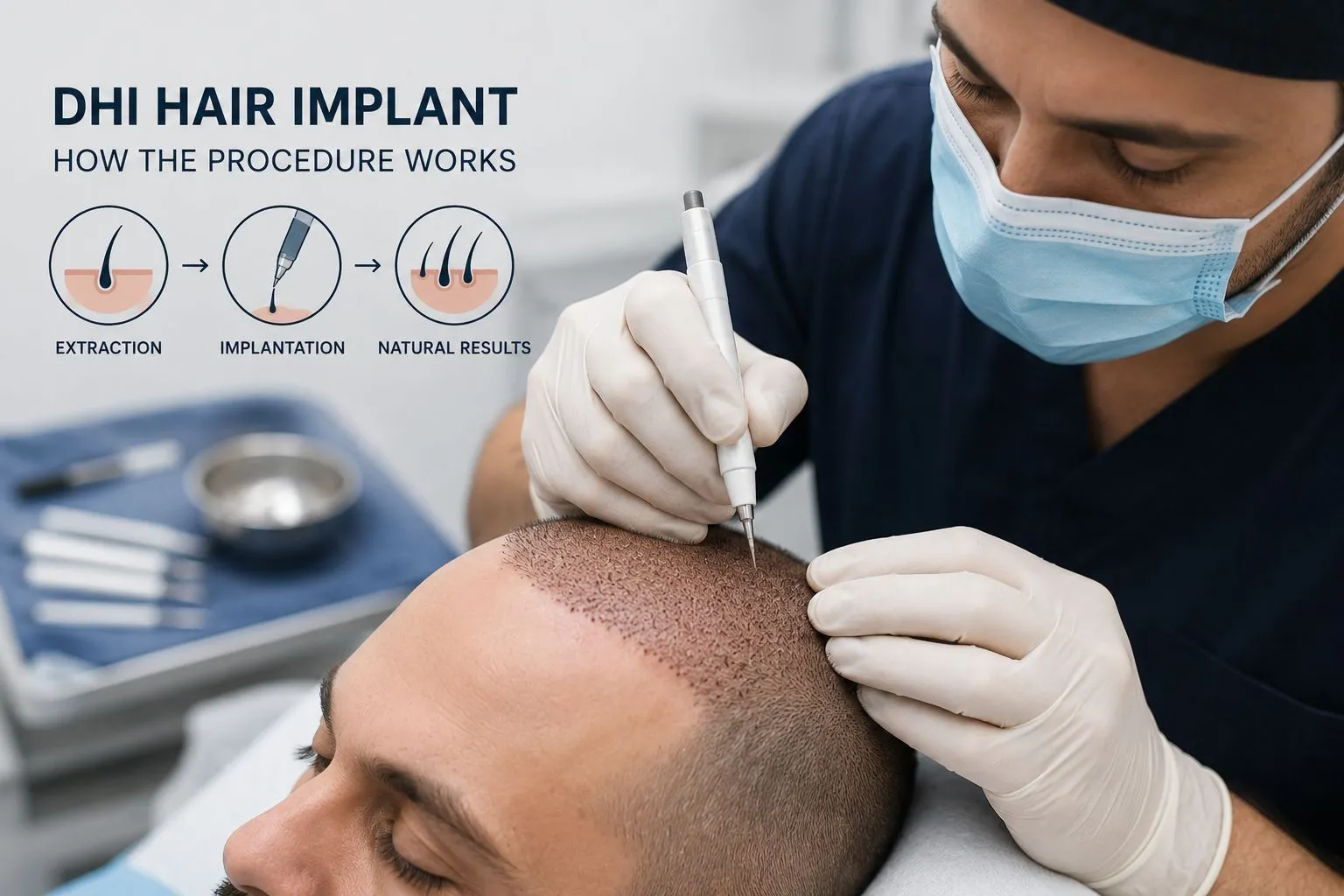
Here's exactly what happens on the day of your procedure, from arrival to the final dressing.
Step 1: Consultation and Scalp Mapping
Before any tool touches your scalp, a specialist examines your donor density, hair loss pattern, and scalp laxity. This is also when your hairline is designed, taking your face shape, age, and future hair loss into account so the result still looks natural a decade from now.
Step 2: Local Anaesthesia
The donor and recipient areas are numbed with local anaesthetic. Most patients describe this as the only mildly uncomfortable part of the entire procedure, and it's brief.
Step 3: Follicle Extraction
Using a fine micro-punch, the surgeon extracts individual follicular units from the donor area, usually one at a time. Because DHI doesn't require shaving the whole scalp, only tiny patches around each extraction site need trimming, which is why it's popular with patients who can't take time off to hide a shaved head.
Step 4: Graft Sorting and Storage
Extracted grafts are sorted by the number of hairs they contain and kept in a specially chilled holding solution. This step protects the follicles and keeps them viable while the surgical team works through hundreds, sometimes thousands, of grafts.
Step 5: Direct Implantation With the Choi Pen
This is the defining step of a DHI Hair Implant. Each follicle is loaded into the hollow needle of the implanter pen, and the surgeon inserts it directly into the scalp at a precise 40-to-45-degree angle, controlling depth and direction in a single motion. There's no pre-cut incision waiting open and exposed, which typically means less bleeding and a gentler recovery.
Step 6: Final Check and Aftercare Briefing
Once every follicle is placed, the scalp is cleaned and a light dressing may be applied. You'll leave with clear washing instructions, medication if needed, and a follow-up date already on the calendar.
Recovery Timeline After DHI
Days 1-3: Mild swelling and tenderness around the hairline, manageable with prescribed medication.
Days 4-10: Tiny scabs form around each graft and begin to flake off naturally. Avoid scratching or picking at them.
Weeks 2-4: Most transplanted hairs shed. This is completely normal and expected; the follicle itself stays put.
Months 3-4: New growth begins to appear.
Months 8-12: Full density and texture become visible.
“Did You Know? The shedding that happens around week three isn't hair loss starting over. It's called "shock loss," and it's actually a sign the follicle is resetting itself before entering a fresh growth cycle.”
Who Makes a Good Candidate?
DHI tends to suit patients who have:
Stable hair loss rather than rapid, ongoing thinning
Enough donor density at the back or sides of the scalp
A preference for keeping their existing hair length during recovery
Realistic expectations about timeline and final density
It's less suited to patients with very limited donor supply, since the technique is more time-intensive per graft and works best when precision, not sheer volume, is the priority.
Benefits and Limitations
Benefits
Minimal scarring, with tiny puncture marks instead of a linear scar
No full-head shave required
Higher graft survival due to shorter time outside the body
Precise control over hair direction, useful for natural-looking parts and hairlines
Limitations
Sessions can run longer than FUE for large areas
Usually costs more per graft due to the skill and time involved
Not always the best fit for patients needing very high graft counts in one sitting
Expert Insight: After years of reviewing consultations at The Skin and Hair Clinic, one pattern stands out: patients who ask about DHI specifically are almost always focused on the hairline, not overall coverage. That's the area where the pen's precision genuinely earns its higher price tag, and it's worth being honest with patients about where the technique adds the most value rather than selling it as a blanket upgrade.
Common Mistakes Patients Make
Judging results too early. Many patients panic during the shedding phase around week three, assuming the transplant has failed.
Choosing a clinic on price alone. Graft survival depends heavily on the technician's experience, not just the tool used.
Skipping the pre-op checklist. Blood thinners, alcohol, and smoking in the days before surgery can all affect graft take.
Pro Tip: Ask your clinic directly how many grafts per hour their team places by hand versus with a pen, and how many technicians will be handling your grafts. Slower, more careful handling almost always beats a rushed high-volume session.
Why Choose The Skin and Hair Clinic
At The Skin and Hair Clinic, every DHI Hair Implant procedure is led by specialists who map your hairline, donor area, and long-term hair loss pattern before a single graft is touched. The clinic combines precise Choi pen implantation with transparent aftercare support, so you know exactly what to expect at every stage, not just on surgery day.
Ready to See What's Possible for Your Hairline?
You don't need to keep guessing whether a transplant will work for you. Book a consultation with The Skin and Hair Clinic and get a personalised assessment of your donor density, hair loss pattern, and realistic results, no pressure, just honest answers from people who do this every day.
FAQs
1. How long does a DHI hair implant procedure take? Most sessions take between 6 and 8 hours, depending on the number of grafts needed. Larger sessions may be split across two days.
2. Is DHI more painful than FUE? No. Both techniques use local anaesthesia, so pain during the procedure is minimal. Post-op soreness is similar for both methods and fades within a few days.
3. Will people be able to tell I've had a hair transplant? Since DHI doesn't require shaving the entire scalp, most patients return to work or social settings within a week without anyone noticing.
4. How many grafts are typically needed for a DHI procedure? This depends on the extent of hair loss, but sessions commonly range from 1,500 to 4,000 grafts for noticeable density.
5. When will I see the final results after a DHI hair transplant? Initial growth starts around month 3 or 4, with full, mature results visible between 10 and 12 months after the procedure.